
Introduction: From Crisis to Stabilisation
Ghana’s economy in 2026 reflects a continuing recovery from the severe macroeconomic crisis that intensified in 2022. The crisis was characterised by persistent fiscal deficits, rapid debt accumulation, sharp cedi depreciation, weak foreign-exchange reserves, loss of access to international capital markets, and exceptionally high inflation. Headline inflation spiked, reaching 54.1% in December 2022 while the cedi depreciated 30% by the end of the same year, and public debt rose to unsustainable levels. Ghana had already lost access to the international capital markets in 2021, leaving the country exposed to refinancing pressures, weaker investor confidence, and a deteriorating external position. In response, Ghana entered an IMF-supported Extended Credit Facility programme and implemented domestic debt restructuring through the Domestic Debt Exchange Programme. These measures were reinforced by fiscal adjustment, restrictive monetary policy, efforts to strengthen external buffers, and reforms aimed at restoring confidence in public finances and the financial system.
The adjustment process imposed meaningful short-term costs. Higher borrowing costs, constrained public expenditure, reduced fiscal space, and weaker domestic demand affected households, firms, and public investment. Nonetheless, the measures helped move the economy away from acute macroeconomic instability. By 2026, Ghana had made significant progress. Inflation had declined sharply from its 2022 peak, foreign-exchange reserves had strengthened, headline public-debt indicators had improved, domestic financial conditions had eased, and the government had resumed longer-term domestic bond issuance following the expiry of DDEP-related restrictions.
However, stabilisation should not be mistaken for the elimination of risk. Headline inflation rose to 5.0% in August 2026 from 4.6% in July, indicating that the final stage of disinflation may be uneven. The cedi, although significantly stronger than at its weakest point in 2024, remains exposed to changes in commodity prices, global financial conditions, fiscal performance, and domestic demand for foreign exchange. The central policy task for the remainder of 2026 is therefore consolidation, not acceleration. Ghana must preserve the gains already achieved while creating conditions for stronger and more durable private-sector-led growth.
Inflation and the Cedi: Protecting the Stabilisation Gains
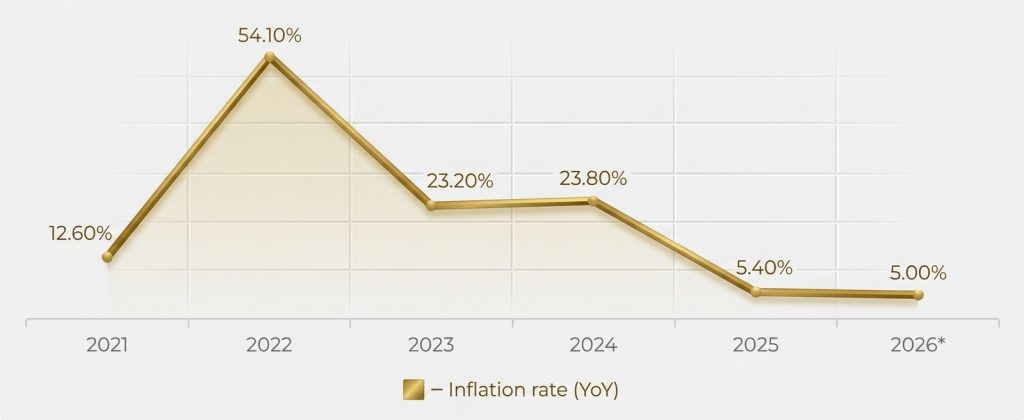
The sharp decline in inflation and the relative improvement in cedi stability are among the clearest indicators of Ghana’s macroeconomic recovery. Headline inflation fell substantially from 54.1% in December 2022 to 5.0% in August 2026. This represents a major correction in the price environment and has improved the outlook for households, businesses, lenders, and investors. Lower inflation reduces uncertainty around costs and returns, improves the predictability of business planning, and can support lower nominal interest rates over time.
However, the recent inflation trend warrants caution. Inflation increased to 5.0% in August 2026 from 4.6% in July and had also risen from 3.7% in May to 5.3% in June. The recent increase suggests that domestic cost pressures, including food, transport, housing, and service-related costs, remain relevant to the inflation outlook.
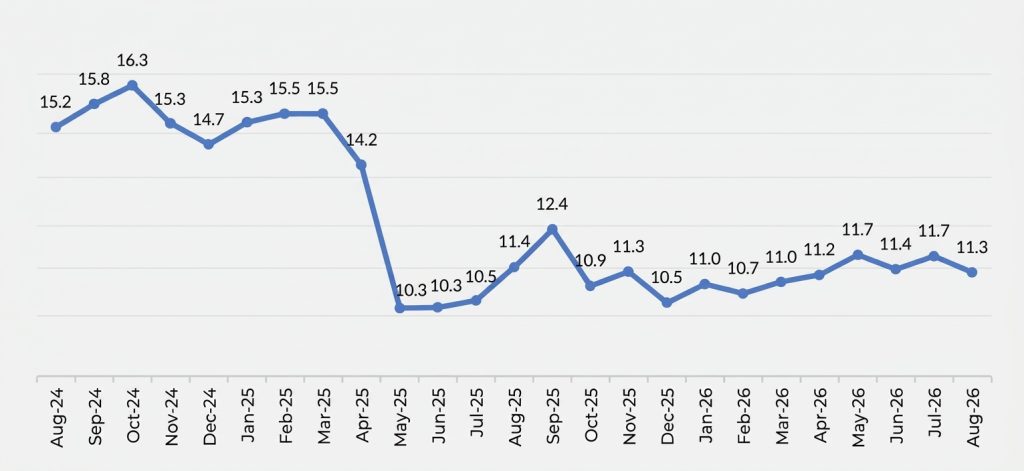
The cedi has also recovered significantly from the extreme volatility experienced during the crisis period. It depreciated from approximately GHS6.02/US$ by 31 January 2022 to around GHS16.30/US$ by 31 October 2024. The currency subsequently strengthened substantially, reaching approximately GHS10.28/US$ by 31 May 2025. By 31 August 2026, the cedi was trading at approximately GHS11.25/US$. This relative stability of the Ghana cedi, coupled with declining inflation, has been supported by tighter monetary policy, fiscal discipline, and improved FX market management.
Figure 1: Ghana Cedi’s Exchange Rate to US Dollar (August 2024 – August 2026)
Source: Bank of Ghana Monthly Exchange Rate Indicators and Agusto and Co. Estimates
The Ghana Gold Board, commonly known as GoldBod, could also play a useful role in strengthening Ghana’s external position. GoldBod’s contribution to the cedi and reserve position depends on its ability to improve formalisation, increase net foreign-exchange repatriation, maintain transparent operations, and avoid creating quasi-fiscal risks. Ghana’s reserve accumulation has also been supported by broader factors, including export earnings, higher gold prices, debt-service relief, fiscal adjustment, and foreign-exchange market management.
The risk to inflation and exchange-rate outlook remains significant. Ghana is dependent on commodity exports, particularly gold, cocoa, and oil, while the country also imports a large share of its refined petroleum products, industrial inputs, machinery, intermediate goods, and consumer products. A sharp decline in gold or cocoa prices, a rise in global oil prices, stronger global risk aversion, or a prolonged US-dollar appreciation could place renewed pressure on foreign-exchange inflows and domestic prices.
Maintaining relative exchange-rate stability and low inflation is crucial for investor confidence, financing conditions, household welfare, and long-term investment decisions. The policy priority must therefore be to build buffers before the next external or domestic shock occurs.
Figure 2: Ghana’s Inflation Rate % (2021 – 2025)
Source: Ghana Statistical Service and Agusto and Co. Estimates
GDP Growth: Sustaining Momentum Without Renewed Imbalances
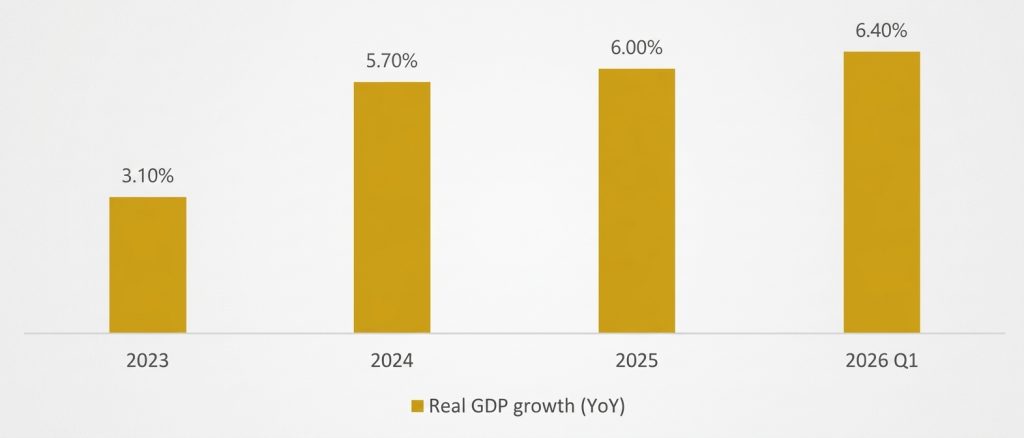
Ghana’s growth performance provides another important sign of improving macroeconomic conditions. Real GDP grew to 6.0% in 2025 from 5.7% in 2024, while the economy expanded by 6.4% year on year in the first quarter of 2026. The Q1 2026 expansion was broad-based across services, industry, and agriculture. This is encouraging because a recovery led by multiple sectors is likely to be more resilient than one driven by a single extractive industry or temporary demand stimulus.
The services sector remained the largest contributor to aggregate growth. It expanded by 7.1% and contributed 48.3% to total real GDP growth. Transport and other services supported the sector’s performance, reflecting the broader recovery in domestic activity and the role of services in employment, consumption, and business activity. Industry was supported by strong growth in mining and quarrying, which expanded by 10.7%. Gold production remained an important driver, reinforcing mining’s significance to industrial output, export earnings, public revenues, and foreign-exchange availability. Agriculture grew by 4.0% and contributed 13.5% to aggregate real GDP growth. Forestry, livestock, and crop production were important sources of growth. Agriculture remains central to employment, food supply, rural incomes, raw-material availability, and cocoa export earnings. Its performance therefore has consequences beyond GDP, including implications for food-price inflation, poverty reduction, and external-sector resilience.
Information and communication technology was the strongest-performing subsector within services. It expanded by 25.2% and contributed 26.9% to aggregate real GDP growth in the first quarter of 2026. This reflects the growing importance of telecommunications, digital payments, data services, software-enabled activity, and broader technology adoption within Ghana’s economy.
The recent growth figures are positive, but the quality and composition of growth remain important. Mining-led growth can strengthen export receipts and public revenues, but the sector may have limited direct employment intensity relative to agriculture, manufacturing, logistics, construction, and consumer-facing services. Similarly, ICT growth is promising, but its long-term economic impact depends on whether it raises productivity across sectors rather than remaining concentrated in telecommunications and digital consumption.
Figure 3: Ghana’s Real GDP Growth Rate (2023 – 2026)
Source: Ghana Statistical Service and Agusto and Co. Estimates
Ghana’s growth strategy should therefore focus on broadening the productive base of the economy. This requires stronger agricultural productivity, improved storage and processing capacity, reliable energy supply, industrial competitiveness, better logistics, export diversification, digital infrastructure, and improved access to finance for firms. The principal risk is that stronger growth could encourage a return to expansionary fiscal behaviour, unsustainable borrowing, or excessive dependence on public spending. Ghana’s recent history illustrates that growth without fiscal discipline, adequate reserve buffers, and credible debt management can quickly lead to renewed inflation, currency pressure, and loss of market confidence. The objective should be to support growth through productivity-enhancing reforms, private investment, efficient infrastructure, and export competitiveness rather than through debt-financed expenditure that could recreate the imbalances of the pre-crisis period.
Financial Markets: Moving from Crisis Management to Normalisation
Ghana’s financial markets are gradually moving towards more normal operating conditions as macroeconomic stability improves. The restrictions on new domestic bond issuance associated with the DDEP expired in early March 2026. This enabled the government to resume longer-term domestic borrowing and marked an important step in restoring the functioning of Ghana’s government securities market.
The government subsequently returned to the domestic bond market with a seven-year bond issuance, reportedly raising GH¢2.7 billion in its first major post-DDEP long-term issuance. This development is significant because a functioning local-currency debt market supports public-debt management, benchmark yield formation, financial-market development, and investment opportunities for pension funds, banks, insurers, and other institutional investors. However, renewed market access should not be interpreted as a licence for a return to excessive borrowing. Ghana’s fiscal crisis was partly driven by high borrowing requirements, widening deficits, rising interest costs, and growing dependence on debt to finance expenditure. A functioning government securities market is necessary, but excessive public-sector demand for domestic funding can absorb bank liquidity, raise market interest rates, crowd out private borrowers, and increase the financial system’s exposure to sovereign risk. The policy objective should be to maintain access to domestic funding while ensuring that a growing share of available capital supports productive private-sector investment.
Investor confidence has also improved. In August 2026, the government reportedly paid GH¢10.8 billion in DDEP coupon obligations in full and on schedule. This was an important demonstration of adherence to the terms of restructured domestic debt and helped reduce uncertainty regarding the government’s willingness and capacity to honour those obligations. It should be viewed as a positive credibility signal, although it is not by itself sufficient evidence of long-term fiscal sustainability.
Financial conditions have also eased materially. The Ghana Reference Rate declined from 23.8% in June 2025 to 10.0% in June 2026, while average lending rates fell from 27.0% to 15.6% over the same period. Private-sector credit growth increased to 41.2% in June 2026, compared with 8.6% a year earlier. Real private-sector credit growth was also positive at 34.1%, suggesting that the increase was not merely a reflection of inflation. These trends matter because government securities influence the price of credit across the financial system. When Treasury yields fall, banks’ funding conditions can improve, risk-free benchmark rates decline, and lending rates may become more affordable. However, the final cost of credit still depends on factors such as inflation, borrower risk, and banks’ own funding costs. The increase in private sector credit is therefore an encouraging indication that improving financial conditions are beginning to reach businesses beyond the government securities market.
The main concern is whether Ghana can sustain renewed market access, lower financing costs and strong investor participation without bringing back the borrowing pressures that contributed to the earlier crisis. The objective should be a financial system in which government can access funding when necessary while a growing share of available capital supports private sector investment and productive activity.
Fiscal and Debt Sustainability: Preserving the Adjustment
Ghana’s fiscal position remains central to the durability of the stabilisation process. Public debt declined from 61.8% of GDP at the end of 2024 to 45.3% at the end of 2025. Nominal public debt also fell from GH¢726.7 billion in 2024 to GH¢641.0 billion in 2025. Over the same period, gross international reserves increased from US$9.11 billion to US$13.83 billion, equivalent to approximately 5.7 months of import cover.
The strengthening of Ghana’s reserve position is particularly important. Higher reserves improve the country’s capacity to meet external obligations, reduce vulnerability to short-term foreign-exchange market pressures, and provide a more credible buffer against adverse movements in commodity prices, import costs, external financing conditions, and investor sentiment.
The improvement in headline debt indicators is also significant, but it should be interpreted with care. The decline likely reflects a combination of fiscal adjustment, domestic and external debt restructuring, exchange-rate and valuation effects, debt-service relief, and growth in nominal GDP. It should not be assumed that the debt burden has become permanently manageable simply because the debt ratio fell in one year.
Ghana’s adjustment programme has constrained the government’s ability to rely on high public expenditure as the main source of economic stimulus. While this may limit short-term fiscal flexibility, it creates an opportunity to improve the quality of public finance. The priority should be to strengthen tax administration, broaden the revenue base, improve compliance, rationalise tax exemptions, reduce inefficient expenditure, and direct scarce public resources towards high-impact infrastructure, human capital, agricultural productivity, energy reliability, and export competitiveness.
However, energy sector liabilities and weaknesses within some state-owned enterprises remain important fiscal risks. If these pressures are not managed effectively, they could place additional demands on the government and weaken the progress made in reducing debt. Ghana’s fiscal position should therefore be focused on consolidation rather than expansion. The priority must be to preserve debt decline, strengthen domestic revenue and maintain an adequate reserve cushion. The sustainability of the gains achieved in the economy will ultimately depend on whether fiscal discipline is maintained as economic conditions stabilise.
Conclusion: Consolidation Before Acceleration
Ghana’s economy in 2026 is in a considerably stronger position than it was during the height of the crisis in 2022. Inflation has declined sharply from its peak, external reserves have strengthened, headline debt indicators have improved, domestic bond-market activity has resumed, and financial conditions have eased.
However, these improvements remain vulnerable to fiscal, external, and financial pressures. A significant fall in gold or cocoa prices could reduce export earnings and FX inflows. Higher oil and energy prices could also increase import costs. Either development could place renewed pressure on the cedi and inflation. Fiscal risks also require close attention. Straying from fiscal discipline will therefore increase government borrowing needs, push up financing costs and weaken investor confidence. Energy sector liabilities and financial problems within state-owned enterprises could also add to these pressures if they are not managed.
As a result, for the remainder of 2026, policy should focus on protecting and consolidating the gains achieved so far rather than pursuing faster growth at the expense of economic resilience. The conclusion of the IMF Extended Credit Facility (ECF) programme should not lead to a relaxation of fiscal discipline, prudent monetary policy, sound debt management or effective reserve management.
Ghana’s progress in 2026 should therefore be viewed as a strong foundation rather than the end of the adjustment process. The real test will be whether the gains in inflation, public debt, FX, financial markets and investor confidence can be sustained long enough to establish a durable foundation for long-term economic development.
